
Tech
How AI Systems in Niger State Are Tackling Urgent Challenges You Can’t Ignore


Spanning the largest geographical area in Nigeria, Niger State is a region characterized by its rivers, rolling hills, and lush green landscapes punctuated by resilient trees. Agriculture sustains millions here, and cultural heritage runs deep. Despite its rural and traditional backdrop, this expansive north-central Nigerian state has embraced cutting-edge technology, with artificial intelligence (AI) already making a tangible impact by saving lives and generating hundreds of millions of naira in savings.
The catalyst for this transformation was a tragic event in 2024 during a government recruitment exercise. Over 10,000 candidates converged on computer-based testing (CBT) centres, resulting in a deadly stampede that claimed two lives. In response, the state government empowered its newly established Ministry of Communications Technology and Digital Economy to devise a safer alternative. Their solution was an AI-driven remote examination platform that allowed applicants to complete tests from home, eliminating the need for physical attendance at crowded centres. This innovation not only prevented further tragedies but also streamlined the process for more than 50,000 candidates, saving the government approximately ₦500 million in operational costs.
“We successfully saved the government ₦500 million,” stated Suleiman Isah, the commissioner leading the initiative, from his office in Minna. “No candidate had to visit any CBT centre during the recruitment.”
Heritage Meets Innovation: Niger’s Digital Awakening
Driving through Niger State, one cannot help but notice the monumental Kainji Dam, constructed in the 1960s, alongside the Jebba and Shiroro Dams from the 1980s and 1990s respectively. These engineering feats symbolize the state’s industrial potential. Yet, for many years, this legacy did not translate into digital advancement. While tech hubs flourished in Lagos and Abuja, Niger State lagged behind, with minimal technological infrastructure or investment.
The tide began to turn in 2023 with the inauguration of the Ministry of Communications Technology and Digital Economy and the appointment of Suleiman Isah as commissioner. Prior to this role, Isah led the state’s Inland Revenue Service, bringing valuable administrative experience to the tech sector.
Before official government involvement, a dedicated group of young entrepreneurs had already been laying the groundwork for Niger’s tech ecosystem. Startups like Binarify Limited, founded by Samuel Adeniyi, Paritie Hub led by Syed Abdullahi, Trecagon by Akin Thompson, P3 Consulting by Nosa Osunde, SchoolSQL by Emmanuel Fayomi, and YKD Consults run by Daniel A. Atteh, have been instrumental in nurturing innovation and digital skills within the state.
“The technology ecosystem in Niger State has significant gaps,” noted Syed Abdullahi during a tech community meeting in Minna on August 8, 2025. “The challenge has never been just about skills, though those exist, but about attracting government and investor attention.” This focus only materialized with the current administration’s commitment starting in 2023.
Umar Auna, who previously led the Google Developer Groups in Minna before joining the Ministry as Startup Desk Officer, recalled the difficulties of engaging with past governments. “Previously, there was no responsive channel for tech innovators to collaborate with the government. That has changed dramatically under the current leadership, which prioritizes technology,” he said.
Infrastructure Progress Amid Connectivity Challenges
Governor Umaru Mohammed Bago has spearheaded one of Niger State’s most ambitious infrastructure projects in decades, including the construction of 556 kilometres of roads across all 25 local government areas, 250 kilometres of intra-city roads in major towns, and 202 kilometres within Minna township. While these developments signal progress, they have also caused disruptions, delaying the deployment of essential telecommunications infrastructure.
By early 2025, Niger State had installed approximately 3,682 kilometres of fibre optic cables, ranking fifth nationwide in fibre coverage. However, actual internet connectivity remains inconsistent due to limited telecom operator presence, resulting in unreliable service for residents and businesses.
“Ongoing roadworks complicate the installation and maintenance of fibre cables, leading to frequent network interruptions,” explained Commissioner Isah. “Protecting fibre infrastructure from damage is a persistent issue.”
Negotiations with major players like IHS Towers and the Nigerian Communications Commission (NCC) to expand network infrastructure have stalled. Consequently, the government is exploring innovative alternatives, such as utilizing existing power lines to deliver fibre directly to households.
Collaborations between the Ministry of Communications Technology and Digital Economy and the Ministry of Works and Urban Development aim to implement a ‘dig-once’ policy by coordinating fibre duct installations alongside roadworks. While the government encourages private sector investment, securing firm commitments remains a challenge.
Currently, most residents rely on mobile networks, which often provide unstable connections. To overcome this, tech hubs like LapPlace Hub, P3 Hub, and Binarify Limited increasingly adopt satellite internet services such as Starlink to ensure reliable high-speed access.
“Starlink has been a dependable solution for our connectivity needs,” shared Prof. Mohammed Aliyu Paiko, Vice Chancellor of Abdulkadir Kure University (AKU). The university, which opened in 2024, hosts GT-Hub, a digital innovation and incubation centre fostering tech talent.
Grassroots Innovation Driving Digital Transformation
Rather than top-down directives, Niger State’s digital evolution is propelled by a vibrant community of innovators combining entrepreneurial spirit with institutional backing. At Abdulkadir Kure University, GT-Hub equips students with skills in AI, data science, and software engineering, encouraging them to develop startups while still in school.
“Our goal is for students to launch successful ventures during their studies,” said Umar Zakari, ICT Director at AKU. “We began with 86 students, training them in cutting-edge fields that define the fourth industrial revolution.”
The Federal University of Technology (FUT), Minna, also fosters entrepreneurship through its Centre for Entrepreneurship, promoting pitching, prototyping, and national competitions. This environment nurtures innovators like Samuel Adeniyi, a mechatronics graduate and co-founder of Binarify Limited, which offers an AI-powered platform that consolidates multiple online stores into a single dashboard, simplifying e-commerce management.
Each month, Adeniyi co-hosts Founders Fridays, a collaborative event organized by the Niger Startups and Innovators Community (NSIC). This gathering serves as a hub for exchanging ideas and developing practical skills in software development, data analytics, and AI, directly contributing to economic growth.
In partnership with the United Nations Development Programme (UNDP), the Ministry is establishing specialized training centres focused on robotics, AI, and drone technology. The NCC has also expanded digital literacy programs, including training 90 internally displaced persons (IDPs) in camps, with some participants attending the Nokia Academy in Abuja for advanced instruction.
Despite these advances, cultural attitudes remain a barrier. “Many still believe the path to success is solely through formal education and government employment, rather than investing in business branding or innovation,” observed Syed Abdullahi.
Empowering the Private Sector: A New Governance Model
Contrary to the typical bureaucratic inertia in Nigerian governance, Niger State’s Ministry of Communications Technology and Digital Economy adopts a facilitative approach, enabling private enterprises to spearhead technological development.
“We face two fundamental questions: Are we here to transform governance directly, or to create an enabling environment?” Commissioner Isah explained. “While e-governance may take years, sustainability depends on empowering the private sector to lead.”
A notable policy is the waiver of right-of-way (RoW) fees for telecom companies, traditionally a significant cost barrier. In exchange, companies must provide free broadband access to all tertiary institutions along their fibre routes. This public-private partnership model ensures infrastructure ownership remains with private entities, while the government acts as a primary beneficiary.
In healthcare, the state introduced the Asibiti system, a unified digital health card network connecting all general and teaching hospitals. This system incorporates a digital wallet to reduce corruption, allows citizens to pre-fund medical expenses, and safeguards patient data privacy while maintaining government ownership.
Education has also been digitized, with the basic education leaving certificate now issued exclusively as a secure digital document embedded with QR codes, eliminating risks of loss or forgery.
Revenue collection has undergone a dramatic overhaul, transitioning to a centralized billing system inspired by the federal Treasury Single Account (TSA). This integration of state and local revenue streams has increased monthly internal revenue from ₦350 million (approximately $219,000) to between ₦3.5 and ₦4 billion (around $2.5 million) within two years.
Practical AI Applications Transforming Daily Life
Niger State’s AI initiatives focus on pragmatic solutions that address immediate challenges rather than futuristic concepts. Two flagship projects exemplify this approach.
The AI-enabled remote examination platform, initially developed to prevent recruitment-related tragedies, has been adopted by Abdulkadir Kure University for staff recruitment tests. In 2025, over 12,000 candidates completed exams remotely, resulting in a transparent, efficient, and fraud-resistant process, according to the university’s Vice Chancellor.

AI is also revolutionizing civil service administration by auditing digitized employment and pension records. The system detects inconsistencies such as impossible birthdates, forged certificates, and duplicate identities, thereby eliminating long-standing abuses and expediting verification.
“We are piloting AI for payroll management,” Commissioner Isah revealed. “It cross-checks age and graduation dates to identify anomalies, such as someone purportedly graduating university at age 12, helping to combat age falsification in the civil service.”
Looking ahead, the government plans to launch an AI-powered contact centre that will automatically route citizen complaints and emergency reports to the nearest response units, eliminating long wait times.
These initiatives may lack the glamour of headline-grabbing AI projects worldwide, but they deliver life-saving, cost-effective, and trust-building outcomes for Niger State’s citizens.
This article was produced with support from the Centre for Journalism Innovation and Development (CJID) and Luminate.
Don’t miss Moonshot by TechCabal, returning to Lagos on October 15-16! Join Africa’s leading founders, creatives, and tech visionaries for two days of inspiring keynotes, networking, and forward-thinking ideas. Early bird tickets are now 20% off-secure yours at moonshot.techcabal.com.










Understanding the Speed of Fintech Transactions Versus Traditional Banks in Nigeria
In Nigeria, it’s a common belief that fintech platforms such as OPay and Moniepoint process transactions much faster than conventional banks. The popular narrative suggests that banks are “slow because they rely on batch processing,” whereas fintechs are “instant due to their use of liquidity pools.” But how accurate is this perception?
The Infrastructure Behind Money Movement in Nigeria
The reality of transaction speed in Nigeria is more complex and depends heavily on the payment infrastructure used by both banks and fintech companies. Central to this ecosystem is the NIBSS Instant Payment (NIP) system, Nigeria’s real-time credit transfer platform. When you send money from one financial institution to another, NIP instructs the receiving party to credit the beneficiary’s account immediately, which is why users often see funds appear “instantly.”
However, what many don’t realize is that NIP does not settle each transaction individually in real time. Instead, it employs a deferred net settlement mechanism. This means that all transactions between banks and payment providers are aggregated and settled in batches at specific intervals throughout the day via the Central Bank of Nigeria’s Real-Time Gross Settlement (RTGS) system.
Historically, NIBSS has conducted two settlement cycles daily, but this has increased to four cycles recently. Regardless of the number, the principle remains: users receive immediate credit, while financial institutions reconcile their accounts during scheduled settlement windows. This hybrid model of “instant credit to users with later net settlement” is a standard approach used by real-time payment systems globally.

Batch Processing Still Exists but Is Not the Norm for Everyday Transfers
While batch systems like Nigeria’s NEFT (NIBSS Electronic Funds Transfer) remain in use, they are typically reserved for less time-sensitive transactions. NEFT processes payments in clearing windows or sometimes on the next business day, which explains why some bank transfers take hours to complete. The key distinction is that NIP offers instant transfers, whereas NEFT operates on batch processing. Many banks and fintech platforms support both systems, which accounts for the variability in transaction speeds experienced by customers.
Delays in bank transfers are often due to factors such as fraud checks, compliance reviews, or system downtimes rather than an inherent limitation of batch processing alone.
Why Fintech Transfers Feel Instant
Fintech platforms differentiate themselves through how they handle funds within their own ecosystems. For example, when transferring money between two OPay wallets or two Moniepoint accounts, no interbank network is involved. Instead, the platform simply debits one internal ledger and credits another, making these transfers instantaneous by design-similar to how transfers within the same bank are always immediate.
When fintech users send money outside their platform, the transaction still relies on NIP. In these cases, fintech companies often connect indirectly through partner banks, leveraging NIP to ensure instant credit to the recipient, with net settlement occurring later.
The term “liquidity pools” is sometimes used to describe fintech operations, but this can be misleading as it evokes decentralized finance concepts. In reality, fintechs maintain safeguarding accounts and prefunded settlement balances to ensure smooth operations.
For Mobile Money Operators (MMOs) like OPay, regulations require customer wallet funds to be held in trust accounts with deposit money banks. This wallet float is not speculative capital but safeguarded funds. Since May 2024, these funds have been insured by the Nigeria Deposit Insurance Corporation (NDIC) up to ₦5 million per subscriber per MMO, providing users with protection similar to bank deposits.
Additionally, fintech platforms pre-fund their settlement accounts with partner banks to prevent transaction failures due to insufficient balances. This practice enhances reliability but does not imply that fintechs are fronting money before it exists.
Ultimately, interbank transfers still follow NIP’s model: instant credit to beneficiaries with deferred net settlement through the Central Bank of Nigeria.

Licensing and Regulatory Frameworks Impact Fintech Operations
The regulatory status of fintech companies also influences their capabilities. OPay operates as a Mobile Money Operator licensed by the Central Bank of Nigeria (CBN), while Moniepoint functions as a Microfinance Bank, fully regulated and supervised by the CBN, with deposits insured by NDIC.
Moniepoint also holds additional licenses for switching and processing, enabling it to offer comprehensive banking services such as full bank accounts, debit cards, and merchant payment solutions, alongside large-scale payment processing.
This regulatory positioning allows Moniepoint to credit customers instantly within its internal ledger and connect directly to NIP for external transfers.
Key Factors Behind Fintech’s Perceived Speed Advantage
The primary reason fintech platforms often feel faster than traditional banks boils down to their technological infrastructure and operational design. Four main factors contribute to this perception:
- Instant internal ledger transfers: Wallet-to-wallet transactions within the same platform bypass external payment rails, making them immediate.
- End-to-end automation: Fintechs automate processes such as retries and reversals. When NIP returns an error, fintech apps promptly update user balances and initiate reversals, minimizing confusion.
- Enhanced user experience: Features like virtual accounts, beneficiary validation, and transparent transaction status updates provide users with real-time insights, unlike banks that often display vague “processing” messages.
- Prefunded settlement accounts: By maintaining sufficient balances in settlement accounts, fintechs reduce the risk of transaction failures due to insufficient funds.

In summary, the speed advantage of fintech platforms in Nigeria is less about bypassing traditional banking rails and more about how they leverage technology, regulatory frameworks, and operational efficiencies to deliver a seamless and rapid user experience.


اقرأ هذا باللغة العربية
Banking Innovations
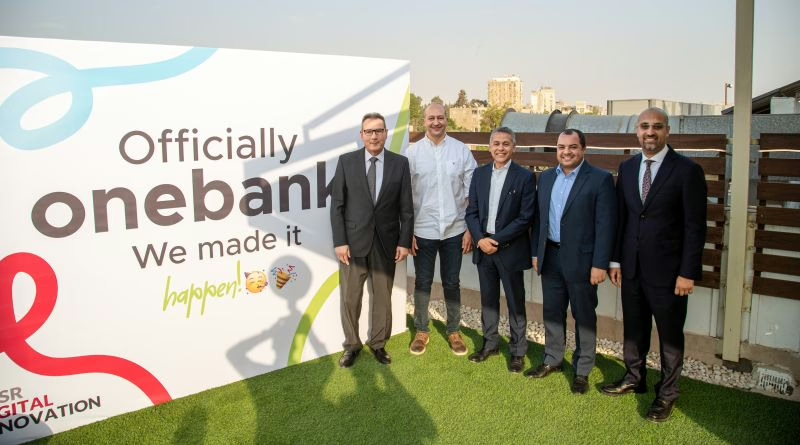
Bank Misr Unveils Egypt’s First Fully Digital Bank: onebank

Egypt’s youth, who are increasingly mobile-first, have eagerly awaited a genuine digital banking experience. This anticipation is now becoming reality.
On August 17, Bank Misr, the nation’s prominent state-owned financial institution, received official regulatory clearance to transform its subsidiary, Misr Digital Innovation (MDI), into onebank – Egypt’s inaugural fully digital bank. The platform is slated for launch in Q4 2025.
Egypt’s fintech ecosystem has flourished over recent years, with companies like Fawry revolutionizing payments and digital wallets expanding access to financial services. According to the Central Bank of Egypt, financial inclusion surged to approximately 70.7% in 2023, a remarkable rise from 27.4% in 2016. However, none of these fintech entities have secured a full digital banking license.
The primary barrier has been stringent regulatory requirements. Digital banking licenses demand a minimum capital of EGP 2 billion (around $42 million), while traditional banks must meet even higher thresholds of EGP 5 billion ($103 million). These financial hurdles have kept smaller fintech startups from independently operating as banks.
The Central Bank has exercised caution, mindful of the risks associated with new banking entrants. Consequently, fintech companies have typically partnered with established banks to offer payment and lending services without holding independent banking licenses.
The launch of onebank marks a pivotal shift. Leveraging Bank Misr’s substantial asset base – the second largest in Egypt – and government support, onebank will operate exclusively online, combining regulatory trust with the agility to compete with fintechs on user experience and service breadth.
For consumers, this means streamlined account setup, instant transfers, and banking products tailored for digital natives who seldom visit physical branches.
Should onebank thrive, it could pave the way for additional digital banks, propelling Egypt’s financial sector into a new digital era.
Banking Sector Developments
Kenya’s Family Bank Reports 39% Profit Surge Amid Expansion

Family Bank, a prominent mid-tier Kenyan lender, announced a robust 39% increase in after-tax profits, reaching KES 2.2 billion (approximately $17 million) in the first half of 2025. This growth was driven by a 26% rise in customer deposits, which hit KES 150.4 billion ($1.17 billion), alongside an expansion in loan portfolios to KES 100.9 billion ($782 million).
The bank’s total assets grew nearly 22% to KES 192.7 billion ($1.5 billion). Net interest income climbed to KES 6.9 billion ($53.5 million), bolstered by government securities and increased lending activities.
However, operating expenses rose by 36% to KES 6.7 billion ($52 million), reflecting investments in branch expansion and digital infrastructure upgrades. Provisions for loan impairments almost doubled to KES 664 million ($5.1 million), despite a 15% reduction in net exposure to non-performing loans.
Seamless Global eCommerce Payments

Whether your customers shop from Lagos or Nairobi, they expect payment options in their local currency-be it cards, bank transfers, or mobile money. Simplify cross-border transactions and accelerate payments for your international online store with Fincra.
Family Bank’s strategic focus on serving small and medium enterprises (SMEs), supported by credit facilities from British International Investment and the European Investment Bank, positions it to capture a specialized market segment. However, this approach also exposes the bank to heightened risks, especially as borrowers grapple with elevated interest rates and sluggish economic growth in Kenya.
Paga Engine: Empowering Africa’s Boldest Innovations

Are your systems ready to support your growing customer base? Don’t let outdated infrastructure limit your potential. Paga Engine offers a fintech foundation tailored for businesses aiming to scale across Africa. Discover more in the full article.
Startups
Craydel Broadens Reach to Burundi and Tanzania

Kenyan edtech innovator Craydel has expanded its operations to include Burundi and Tanzania, increasing its presence to seven African countries. Established in 2021, Craydel utilizes an AI-driven platform to assist students in applying to international universities by matching them with institutions that best fit their profiles. This expansion marks Craydel as the first Kenyan education startup to achieve a truly pan-African footprint.
In case you missed it: Earlier in 2024, Craydel entered the Rwandan market-its fourth expansion within a year-demonstrating an aggressive growth trajectory. Supported by over $2.5 million in venture capital from investors like Enza Capital and Angaza Capital, Craydel positions itself as a local alternative to global education platforms such as Canada’s ApplyBoard and Australia’s IDP Education. Its strategy hinges on leveraging cultural familiarity and local insights to build trust with African students.
Why this matters: Annually, more than 400,000 African students seek higher education abroad, yet the process remains fragmented and dominated by foreign platforms and scattered agent networks. Craydel aims to simplify this journey by providing impartial advice and empowering students with greater control. Its move into Burundi and Tanzania signals a focus on emerging markets beyond Africa’s largest economies, where demand for international education continues to grow.
Wider context: Africa’s edtech sector is projected to be worth $30 billion annually, fueled by a youthful population and increasing aspirations for global education. By rapidly entering underserved markets, Craydel is not only pursuing growth but also aiming for profitability. With further expansions planned, the startup is positioning itself as a key gateway for African students aspiring to study abroad.
Paystack’s Milestones in 2024

Discover the innovations Paystack introduced last year-from significant product enhancements to new initiatives supporting African enterprises. Explore our comprehensive Year in Review →
Features
Along: Bridging the Gap Between Uber and Traditional Transport

Consider this: over the past ten years, approximately 2,500 local ride-hailing startups in Nigeria have launched only to shut down, largely due to insufficient network effects.
While global players like Uber, Bolt, and Indrive dominate Nigeria’s ride-hailing market, many local challengers such as Hytch and Gomyway have struggled to gain traction.
For most Nigerians, cost-effectiveness outweighs comfort, making ride-hailing services priced above traditional public transport a luxury rather than a necessity.
Dolapo Obat, CEO of the ride-sharing startup Along, approaches this challenge differently. He believes that successful ride-hailing solutions must align with Nigerians’ existing commuting habits. Along embodies this philosophy.
Imagine a digital version of the traditional minibus or korope. Passengers start their journey at designated stops, reserving seats along shared routes through the app. Similar to the danfo system, riders might transfer between vehicles mid-route, but the entire trip is coordinated digitally. Pricing is per seat, not per vehicle, mirroring offline shared transport costs.
Along emphasizes safety and affordability, charging fares comparable to public transport and taking a modest 10% commission-much lower than typical ride-hailing platforms. Nevertheless, the startup faces significant challenges, including scaling its technology, navigating union regulations and informal transport operators, and achieving widespread user adoption.
Faith Omoniyi delves deeper into Along’s vision and challenges in this detailed Backend feature.
Secure Financing with Oxygen X

At Oxygen X, loans are crafted to accelerate your ambitions. Whether it’s your initial borrowing or subsequent ones, enjoy competitive rates, adaptable repayment plans, and dedicated assistance. Experience the difference with Oxygen X-because your future deserves the best.
Cryptocurrency Market Insights
Navigating the Expanding Web3 Ecosystem
Data Source:

| Cryptocurrency | Current Price | 24-Hour Change | 30-Day Change |
|---|---|---|---|
 Bitcoin Bitcoin |
$113,496 |
−1.52% |
−4.11% |
| Ethereum |
$4,160 |
−1.54% |
+10.75% |
| Succint |
$1.15 |
−8.51% |
+26.60% |
| Solana |
$180.21 |
+0.26% |
−2.84% |
* Prices and changes accurate as of 06:20 AM WAT, August 20, 2025.
Emerging Opportunities
-
MEST Africa has launched applications for its 2026 Artificial Intelligence Startup Program. This year-long initiative targets West African software developers aged 21 to 30, providing comprehensive training to build scalable AI ventures. The program includes seven months of immersive training in Accra starting January 2026, followed by a four-month incubation phase for standout teams. Deadline for applications is August 22, 2025. Submit your application here.
-
Nithio is extending flexible funding ranging from $50,000 to $500,000 to clean energy startups operating in Kenya and Nigeria. Eligible enterprises include providers of solar home systems, clean cooking solutions, and sellers of energy-efficient appliances such as solar refrigerators and mills. Applications opened July 21; find out more.
-
SheScales Africa presents a 6-week intensive Investment Readiness Program tailored for female tech entrepreneurs across Africa. Given that women-led startups receive less than 2% of venture capital funding on the continent, this program offers expert-led workshops, pitch deck refinement, financial modeling assistance, personalized coaching, and an exclusive Demo Day featuring active investors. Apply now to enhance your fundraising potential.
-
The Lagos Venture Finance Summit, scheduled for September 5, 2025, will spotlight Africa’s dynamic venture capital landscape. Organized by Vencapital, the event will convene leading limited partners, general partners, policymakers, and ecosystem stakeholders for strategic discussions, networking, and deal-making opportunities. Register here to participate in shaping Africa’s investment future.


Authors: Emmanuel Nwosu, Kenn Abuya, Faith Omoniyi
Editor: Faith Omoniyi
Stay Connected with TechCabal
Subscribe to our newsletters for expert insights on Africa’s tech economy and business trends.
- The Next Wave: In-depth forecasts on Africa’s tech business landscape.
- TC Scoops: Breaking news and updates from TechCabal.
- TNW: Francophone Africa: Exclusive analysis of Francophone Africa’s tech ecosystem.
P.S. If you’re missing TC Daily in your inbox, check your Promotions folder and move any TC Daily emails to your Primary tab to ensure you never miss an update.



I Haven’t Had a Baby Yet, But I’m Open to the Possibility

NGX Equities Plunge: Investors Suffer Massive N781bn Loss in Just Five Hours

Big Zulu Triumphs: Celebrating Major Milestones of His Hit Song “Mthulise
-

 Fashion9 years ago
These ’90s fashion trends are making a comeback in 2017
-
Entertainment8 years ago
The final 6 ‘Game of Thrones’ episodes might feel like a full season
-
Fashion9 years ago
According to Dior Couture, this taboo fashion accessory is back
-
Entertainment9 years ago
The old and New Edition cast comes together to perform
-
Sports9 years ago
Phillies’ Aaron Altherr makes mind-boggling barehanded play
-
Entertainment8 years ago
Disney’s live-action Aladdin finally finds its stars
-
Business9 years ago
Uber and Lyft are finally available in all of New York State
-
Sports9 years ago
Steph Curry finally got the contract he deserves from the Warriors